Where Time Lingers: Living Among Centuries at the Kartause
Student Perspective: An article by Garima Sharma, Nepal (RBC 2025-27)
Ever since I was a child, I have been drawn to places steeped in history and legacy. Given a choice, I would always choose decaying, warm-toned walls and pillars, weathered by time and threaded with vines and cracks, over sterile, lifeless structures. The idea that buildings, places, and objects outlive their users and carry their stories in scratches, flaws, and repurposed forms has always sent a quiet warmth through me. Perhaps it was fate, or perhaps it was my rather passionate five-minute declaration of love for such artefacts during my selection interview, that led me to attend RBC: a campus rich with overlooked history.
I still remember my first walk around campus the morning after I arrived. Everything felt ready to be explored, touched, and pondered. I passed beneath the arch of the main entrance. Above it, almost easy to miss, stands the figure of Saint Vitus, watching over the entrance as he has since the mid-18th century. I often wonder how many people have passed under that same arch before me: monks, farmers, scholars, aristocrats, residents of the nursing home, and now students from over 90 different countries, all briefly intersecting in the same space across time.
A Library Shaped by Centuries
Then I found my way to the library. It is impossible to enter without noticing how much of its charm remains: the quiet hum of pages turning, the faint, almost sweet scent of books. And the windows. Coloured light filters through stained glass that feels both present and displaced, as if it belongs to another time entirely. Some fragments of the Kartaus’ original windows, designed between the 16th and 19th centuries when artists like Hans Baldung Grien were working in the region, now sit behind museum glass in places like the Augustinermuseum. Seeing them there, removed from their original setting, made their absence feel even more pronounced and reminded me of the sanctity of the hall where I now carry out my panicked study sessions.
And yet, the room itself was never meant to be a library. It is said the present-day library used to be a cafeteria for the Carthusian monks, and then a chapel. The monks who lived here did not gather in grand halls to read together; their lives were built around solitude. Books would have been kept in their individual cells, read in silence and isolation. And still, figures connected to this place helped shape the intellectual world beyond it. Gregor Reisch, while at the monastery in the early 1500s, wrote one of Europe’s first printed encyclopedias. His student, Martin Waldseemüller, would go on to be the first person to name the continent ‘America’. Sitting here now, surrounded by IB textbooks and laptops, it is hard not to feel that continuity: that the pursuit of knowledge has lingered here, even as everything else has changed.
A Place That Keeps Changing
Not all who lived here would have imagined, or approved of, what the Kartause has become. Heinrich Hansjakob, a priest who spent years writing in what are now classrooms, was deeply critical of modernity and opposed many ideas that define a place like UWC today. Yet there is something almost ironic in that contradiction. A man who resisted change lived in a place that would itself transform again and again: monastery, aristocratic residence, nursing home, school. It makes the present feel less fixed, a quiet reminder of impermanence in a building that has survived through time.
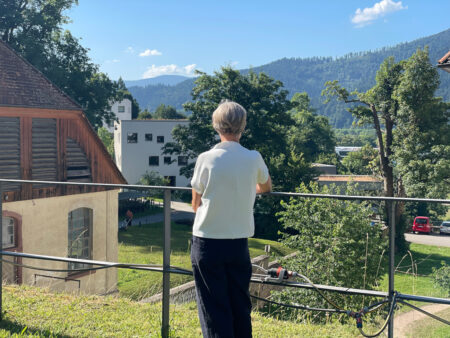
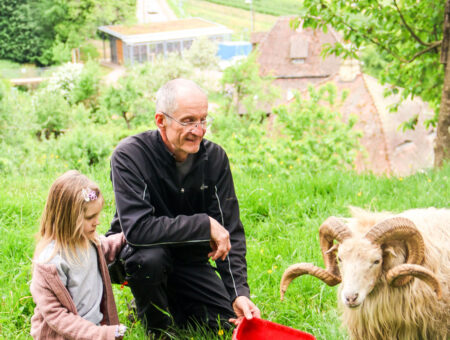
Behind the main buildings lie the remains of what might be my favourite part of campus. Low, crumbling walls stretch across the grass. This was once the heart of Carthusian life: the monk cells, each a small, self-contained world of near-total silence. Now, sheep graze where those lives once unfolded. A small monument lies there, stones painted with names and memories. A decaying, rusting metal cross stands, enduring seasons and monumental change. Spending time there, it is easy to detach from the present and find solace in the decaying.
The Garden as Living History
Beyond the buildings, the garden stretches in front of the campus. It has been cultivated, in one form or another, since the monastery’s founding in the 14th century. What was once a kitchen garden for monks became an ornamental space, then part of the nursing home, and now a school garden again. The continuity is subtle but persistent. Even now, when I walk through it, I imagine what it must have looked like centuries ago: monks tending the soil in silence, the same ground, the same rhythm. As I dig through the mud on garden days, I am reminded of how much this space has given back through centuries of care.
It is easy to forget that for much of its more recent history, the Kartause was not seen as beautiful or historically significant, but as a place for those who had nowhere else to go. For decades, it functioned as a nursing home, carrying the weight of age, illness, and social neglect. It was referred to as a “poorhouse”, defined less by legacy and more by necessity. And yet even that phase feels strangely poetic. The buildings adapted, endured, and absorbed new meanings without losing the traces of the old ones.
Walking Through Time
Sometimes, walking along the paths near the Dreisam or the old ruined walls behind the school, I catch myself imagining the footsteps of those who came before me. Carthusian monks moving silently between cells. Craftsmen working along water channels that have existed here for centuries. Perhaps even medieval travellers passing through, unaware the place would still be standing hundreds of years later. I find myself feeling something similar to what Felix Mendelssohn captured in 1837 when he sketched the Kartause in his journal: a quiet admiration for the beauty of its legacy.