Humans of RBC: “The courage to stay curious”
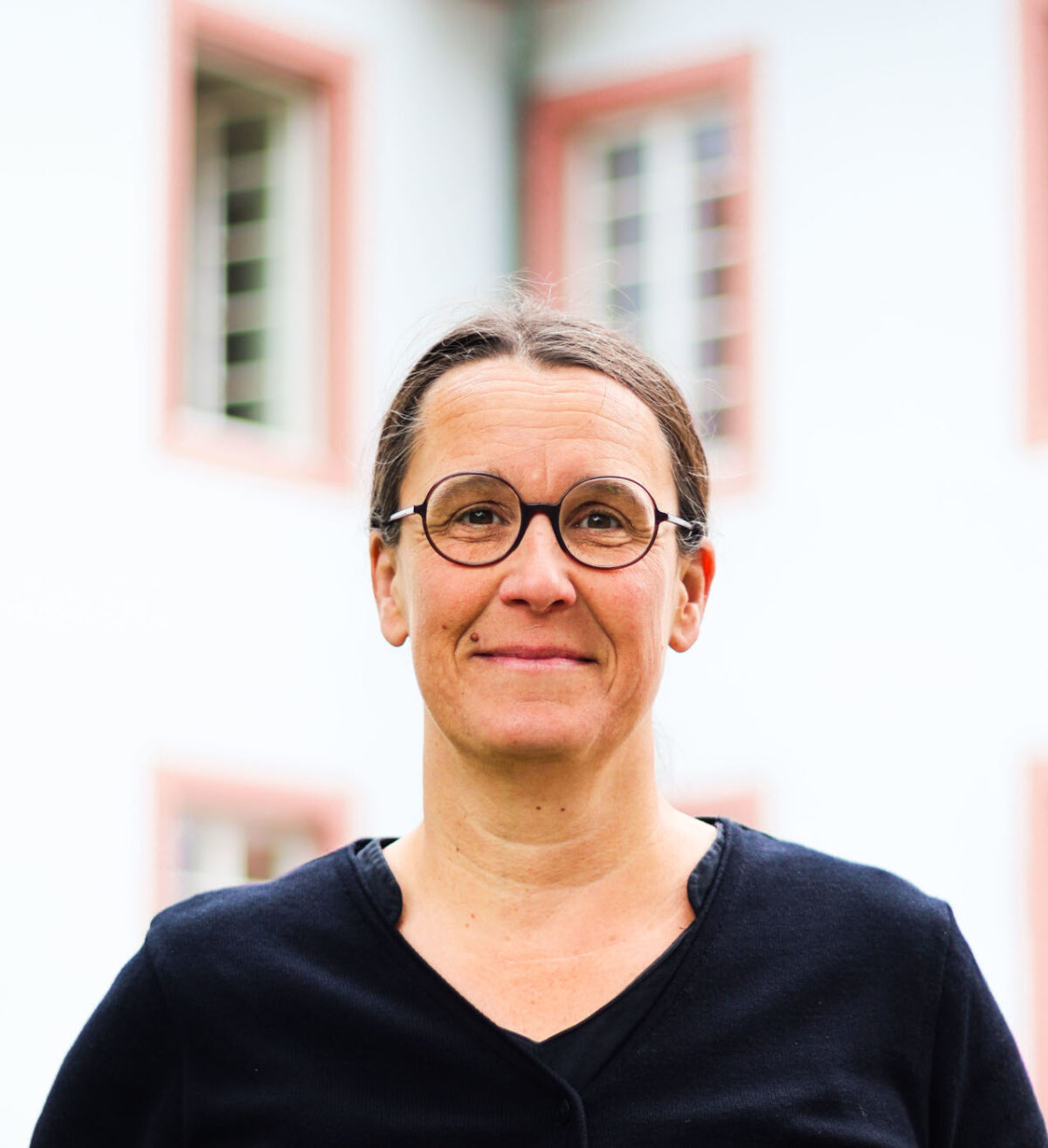
An interview by our student Clara Christ with Caroline Mavergames, Librarian and EE & Global Affairs Coordinator at RBC
Can you please introduce yourself?
My name is Caroline. I’m the librarian and EE Coordinator at RBC, and I’ve been working here since the school opened.
Now, can you please introduce yourself without mentioning your name or your role at RBC?
I’m originally from Freiburg, but I spent eight years living in New York City in my twenties before somehow finding my way back here. I’ve now lived in Freiburg with my American husband for twenty years. I love reading, swimming, hiking, and playing games, and I’m a mother of two sons, a friend to my friends, and a sister to four siblings.
What brought you to RBC and what does being part of this community mean to you now?
My brother sent me the job advertisement when the school was about to open. The opportunity to work in an English-language library was exciting because I earned my librarian degree in the US. I hadn’t worked in school education before, but it immediately interested me, and I’m still very grateful to have gotten the job.
Working here and being part of this community has been somewhat life-changing. I learn every day, and it has made me more courageous and more curious. What I appreciate most is the respect between everyone: staff and staff, staff and students, students and students. There is genuine care for one another and a shared joy in growth and learning that isn’t self-centered.
Last summer, my son did an internship with the school maintenance team. After having lunch with us, he said, “Mama, this is kind of like a utopia. Teachers just sit with students and everyone is having a nice time.” I don’t like idealizing UWC, but compared to many traditional school environments, where hierarchies and separation are more pronounced, this place is very special. I don’t take that for granted.
You’re the librarian of RBC’s beloved library. Is there a book that you would recommend to an incoming RBC student?
There can’t be just one book! The way I try to run the library is that students can find fiction from many different places and perspectives. So my recommendation would be to read something from another culture, another part of the world.
But honestly, we live in a time when simply reading any book is something I would recommend. Pick up a book, slow down, engage different parts of your brain, and just see what it does to you. Ideally, choose a book about something completely new to you.
And if you had to give a concrete recommendation? What’s, for example, the last book that really impressed you?
There are so many! The first person who comes to mind is Chimamanda Ngozi Adichie, known for her famous phrase, “There is no single story.” Any of her books will make you look at the world differently.
Another role of yours at RBC is coordinating the IB Extended Essays. Why do you think this type of academic work matters for students living in today’s world?
Being able to sit down, focus on one question, and pursue it deeply rather than broadly is valuable training. It develops your focus, discipline, creativity, ability to express yourself, and motivation to dig deeper.
For me, it’s about moving from a passive, consumptive mode into an analytical and expressive one. Some might say that with AI becoming so powerful, this kind of work is no longer necessary. I think the opposite is true. AI is a tool that can help us do things more quickly, but doing the deep work yourself helps you become a truly inquisitive person.
Especially when you’re young, you don’t yet know what your brain is capable of or what skills you can develop. The EE can be a major opportunity to discover that.
You are also involved in organizing the Global Affairs sessions. Can you summarize what Global Affairs is in three sentences and tell us your most memorable Global Affairs experience?
Global Affairs is RBC’s way of connecting what we learn inside the school with the wider world. We invite people with expertise and unique experiences to share their knowledge with our community. It is a format that helps develop listening, understanding, and interaction skills.
I enjoy being involved because a librarian’s work is not really just about books – it’s about connecting information with a need, and that’s exactly what Global Affairs allows me to do. Sometimes you browse a shelf and discover a book you never expected to find. Similarly, you attend a Global Affairs session, hear someone speak, and learn something you never expected. That sense of discovery is beautiful to me.
The most memorable speaker for me was Stella Nyanzi, a Ugandan poet living in Germany as a writer in exile. One of our students, who loved her poetry, reached out to her. Through her visit, we gained insight into her activism in Uganda and her experience of imprisonment. As a form of political protest, she used nudity to challenge the government. She was truly a force of nature – intelligent, kind, and relentless.
What’s your favourite place on campus and why?
I can only say the library. If I had to be locked up somewhere forever, it would be in a library – ideally our library.
Beyond that, it’s really the entire campus. Every day I come here, I feel grateful to be in this environment.
What gives you hope or keeps you motivated to work towards a more peaceful and sustainable future?
I believe that I was born an optimist. My generation experienced what often felt like continuous progress: greater recognition of women’s rights, marriage equality, and, for many of us, the privilege of growing up with stability and security. Because of who I am, I can’t help being hopeful. And because of that background, I also feel a responsibility to be engaged and to believe in the possibility of a better future.
The other source of motivation is how much I have read over the years. All those stories, lives, and possibilities live inside me and inspire me. Some of them are frightening – I read dystopian fiction too – but many of them give me hope. They make me feel more prepared for whatever the future may bring, and they remind me that people can always try to make things better. That sustains me.