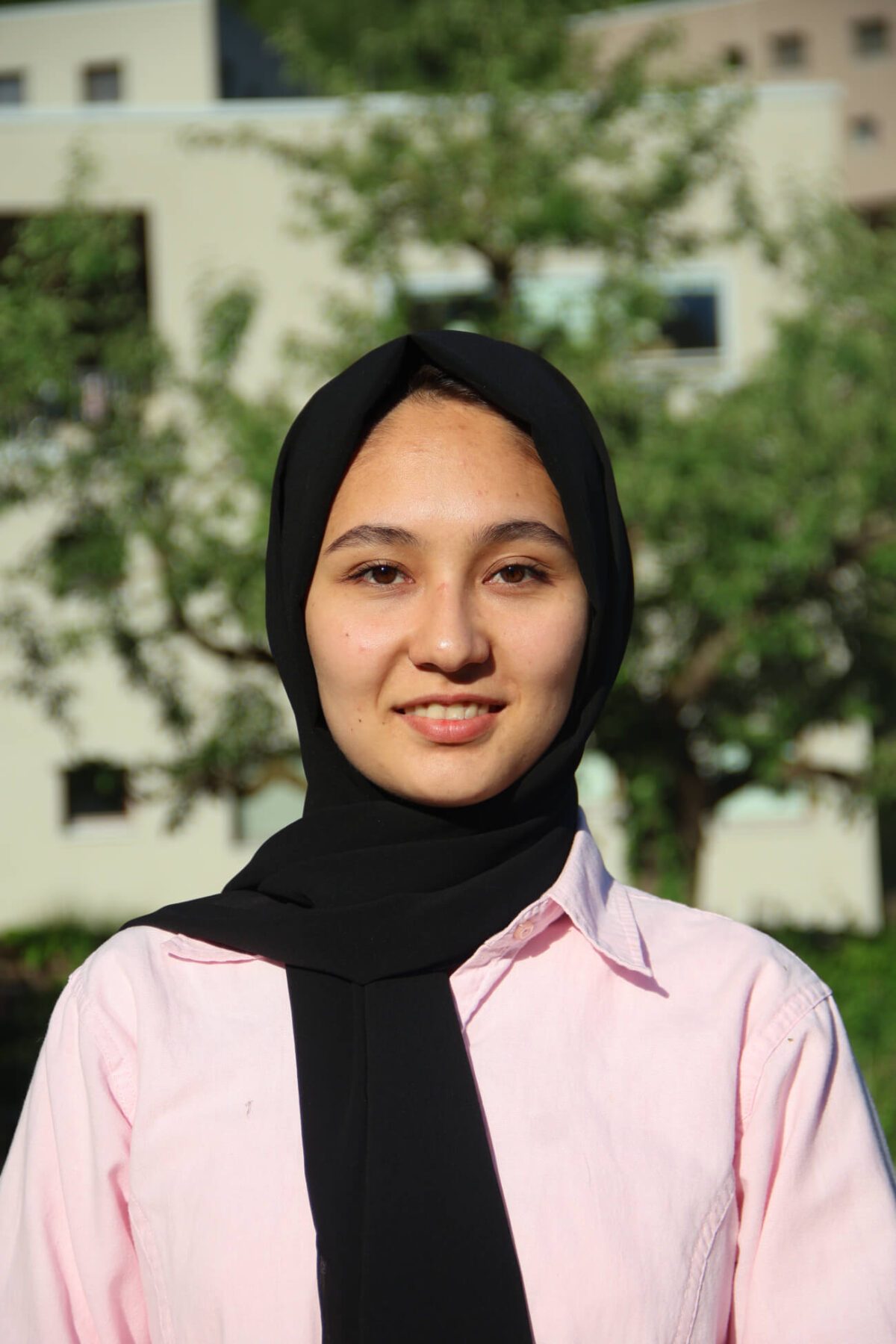
Student Portrait: Where Learning Means Belonging
Farzana Motamedi is used to answering a difficult question: Where are you from?
“I struggled with that at first,” she says. “But I always come back to Afghanistan.”
Born to Afghan parents in Iran, she moved to Kabul at the age of seven. It was there that she first understood what belonging meant. “The moment I crossed the border, I felt: here, I am no foreigner.” Despite growing up between cultures and speaking Persian with an Iranian accent, she was welcomed without question. Afghanistan became home; not just a place, but a feeling.
That feeling was deeply shaken in 2021.
On August 15, what began as an ordinary school day ended in uncertainty. Farzana had just taken a computer science exam and said goodbye to her classmates, expecting to see them the next morning. By the afternoon, everything had changed. Schools closed. At first, it seemed temporary. But when they reopened, only boys and younger girls were allowed back. “For some people, going to school is a routine,” she says quietly. “For others, it’s a dream.”
For Farzana, education had always been more than routine: it was purpose, identity, and possibility. Losing access to it felt like losing a part of herself. “I didn’t feel like I belonged anymore,” she says. The place that once embraced her no longer allowed her to pursue what she loved most.
And yet, what stayed with her just as strongly was not only the loss – but the resilience she witnessed around her. Afghan girls’ resilience remains a defining part of how she sees the world. She speaks with deep admiration about their determination to keep learning, even under extreme restrictions. “I really admire how hopeful and brave the girls are,” she says. “Even in the worst situation, they try to continue learning in any way they can.”
She recalls how they used every opportunity available – joining book clubs, studying online, or learning in small groups. Their persistence, she says, has stayed with her.In 2023, her family left Afghanistan. After a period of transition, they arrived in Germany, where Farzana had to begin again – new country, new language, new system. After nearly three years without formal schooling, the gap felt immense. Teachers initially doubted whether she could complete her Realschulabschluss within a single year.
But Farzana insisted. “I had already lost three years,” she says. “I didn’t want to lose another one.”
The first months were overwhelming. She translated lessons word by word, into English, into Persian, trying to keep up. Slowly, she found her rhythm. And then, something remarkable happened: she didn’t just pass. She finished as the top student in her year.
Her achievement surprised many. For her, it carried a different meaning. “I felt responsible,” she explains. “There are so many girls who want to study but can’t. I have this opportunity, I have to use it.”
Today, Farzana is a first-year student at RBC. Recently elected as Student Secretary, she now represents her peers in the Student Council. A few months ago, she stood in front of the entire school and gave a speech about education – about what it means, and what it costs when it is taken away. Many in the audience were moved.
At RBC, she has found something she once thought she had lost: a sense of home. “It’s the closest feeling I’ve had since 2021,” she says. In a community where students come from all over the world, not fully belonging becomes something shared – and something that brings people together.
Her curiosity extends beyond the classroom. She speaks multiple languages – Persian, English, German, and some Pashto – and has a deep love for poetry, especially the works of Hafez and Rumi. “Poetry can say in one line what would take a paragraph otherwise,” she says. It is, for her, another way of holding onto meaning.
What comes next is still open. She is drawn to the social sciences and humanities, perhaps business, but always with a clear intention: to contribute, to engage, to create opportunities for others. If given 30 seconds of the world’s attention, her message would be simple: “Don’t overthink. If you have an idea, take the first step. Even a small step can grow into something meaningful.”